
ChinAI #327: Critiquing China's AI Plus Plan
A Strategic Reading of China’s Three-step AI Strategy for the Next Decade
Greetings from a world where…
another season of a one-dimensional Iowa Hawkeyes offense beckons
…As always, the searchable archive of all past issues is here. Please please subscribe here to support ChinAI under a Guardian/Wikipedia-style tipping model (everyone gets the same content but those who can pay support access for all AND compensation for awesome ChinAI contributors).
Feature Translation: The Nation Sets the Tone for “AI Plus”
Context: Last week’s Around the Horn vote produced a runaway winner: a strategic reading of China’s AI Plus initiative (link to original Chinese), from Synced (jiqizhixin). My readers love a plan. Last month, China’s State Council released implementation guidelines for its AI Plus initiative, which was initially proposed in a 2024 work report. The jiqizhixin report deems these implementation guidelines as more targeted and systematic than China’s New Generation AI Plan from 2017.
And you all were right to choose this one: it’s a useful breakdown, and more importantly, it serves as a good launching pad for me to give some grouchy comments and hot takes.
Key Takeaways: The plan positions AI as China’s key growth engine for the future (“the core of new quality productive forces”, according to jiqizhixin’s reading). In the past, these productivity forces have included emerging industries such as nuclear fusion or quantum computing. Here, AI stands above the rest. These implementation guidelines lay out three-step blueprint:
By 2027: achieve over 70% penetration rate of intelligent terminals and agents in six key sectors.
By 2030: achieve over 90% penetration rate of intelligent terminals and agents across the entire economy.
By 2035: AI will usher in an intelligent economy and society. The jiqizhixin report interprets this as: “AI will be as universally adopted as electricity and the internet, becoming the ‘base infrastructure’ of society.”
Let’s go through some of the planks that stood out to me. First, the six key sectors targeted for a 70% AI adoption rate are: science and technology, industry, consumption, social well-being, governance, and global cooperation.
This is such a weird mishmash of industries to highlight as early adopters. Global cooperation is: a) not really a sector, b) will see much slower AI diffusion as compared to, say, finance, and c) does not have an outsized impact on economic productivity. Industrial devevelopment, the second sector listed, basically includes the entire economy, as it includes industry, agriculture, and services. The one that makes sense to me is AI for science, as a promising application sector where AI could “transform the R&D chain, significantly shortening the distance between the laboratory and the market.”
The goals and timelines are unbelievably optimistic, especially 90 percent adoption rate across the entire economy by 2030! As the article points out, “The 90% figure means that nearly every industry, every organization, and even the majority of individual users will be using smart devices or agents, moving AI from application-specific landing towards an economy-wide driver.”
People often ask me if I think that Chinese policymakers are reading my book. It makes me laugh for a number of reasons. First of all, I doubt many people have actually read the whole book. So, no, Xi Jinping and his advisors are not poring through my duration model of how fast 76 different countries reached a certain level of computerization. Even my wife skipped that section.
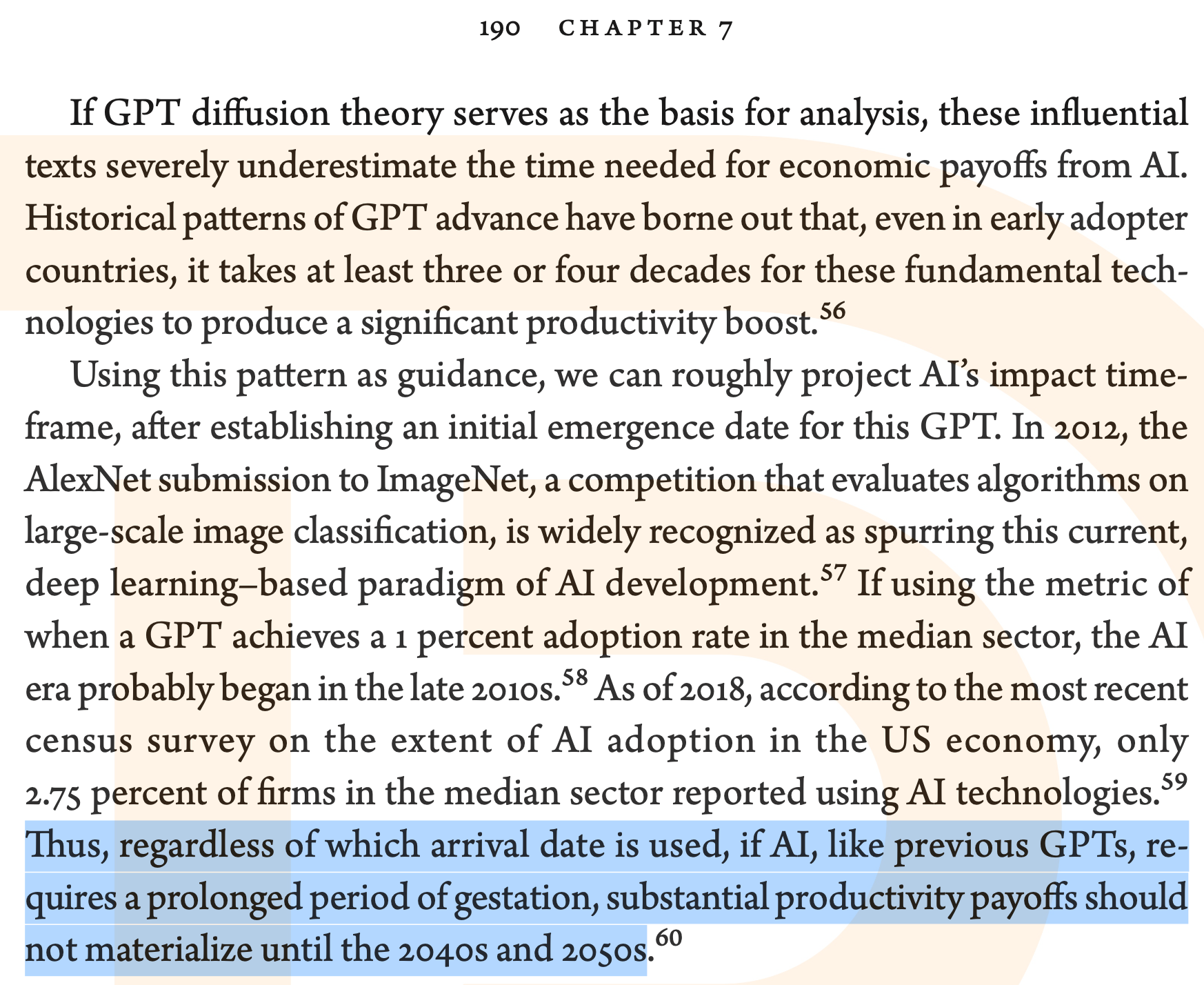
Second, if Chinese leaders were taking my book seriously, they would have picked a very different benchmark. In the section titled, “The Decisive Years in the US-China AI Competition,” here’s what I wrote, “Thus, regardless of which arrival date is used, if AI, like previous GPTs, requires a prolonged period of gestation, substantial productivity payoffs should not materialize until the 2040s and 2050s.”
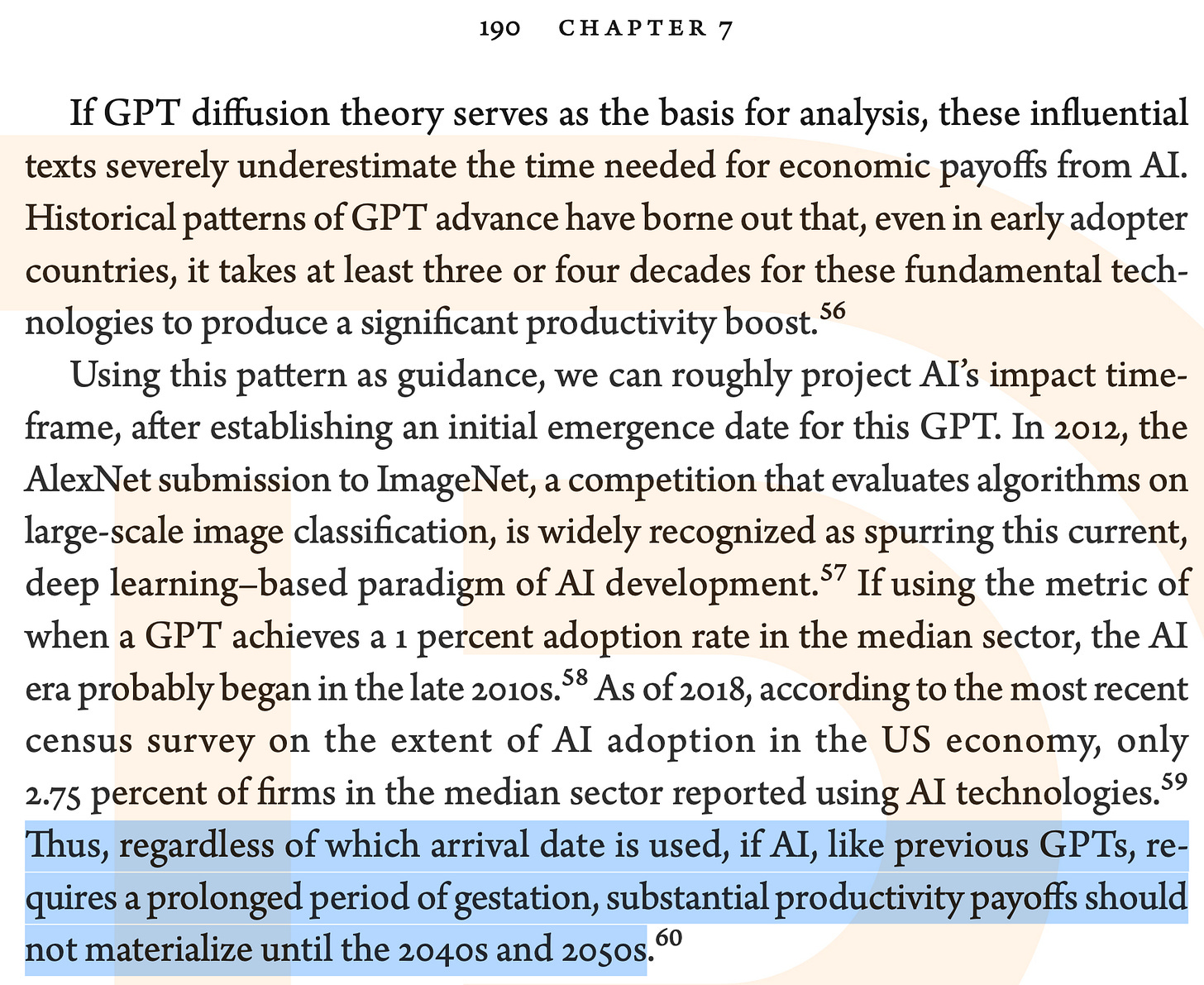
Ding, Jeffrey. Technology and the Rise of Great Powers: How Diffusion Shapes Economic Competition. Princeton University Press, 2024. Stay with me here as we run the numbers. How long does it usually take for a general-purpose technology (GPT), like AI, to make its mark? The first step in this exercise is to establish an “arrival date” for the GPT. My book uses Jovanovic and Rousseau’s measure1 of when a GPT attains 1% adoption in the median sector. According to this approach, electricity arrived as a GPT in 1894, and the computer arrived as a GPT in 1971. Based on these arrival dates, it took over three decades for both electrification and computerization to reach 70 percent of households in the U.S. (the fastest adopting country). *Note: According to Jovanovic and Rousseau, it took even longer than three decades for the median manufacturing sector to achieve 70 percent adoption of electricity (as a share of total horsepower)
In Technology and the Rise of Great Powers, I estimate AI’s arrival as a potential GPT to sometime in the mid-to-late 2010s. This is based on a 2018 census survey metric, with 2.75 percent of firms in the median sector reporting the use of AI technologies. If AI follows the path of electricity and the computer, we will not even get close to 70 percent adoption across the economy — let alone 90 percent! — until after 2040.
In sum, to my friends who are so afraid of information hazards that they forget how to produce information in the first place: Don’t worry! I have not written a playbook for Chinese leaders to adopt. They probably aren’t reading it; and if they are, they’re certainly not reading it closely.
Okay, I should say something nice about these AI Plus implementation guidelines, which should be complimented for taking diffusion seriously. I did appreciate the sections on open-source communities: “Establish evaluation and incentive mechanisms for open-source contributions, and encourage universities to recognize such contributions in student-credit and faculty-assessment systems” (translation from the superb Geopolitechs newsletter).
Two things can be true at the same time about China’s open-source AI ecosystem. First, Chinese labs are dominant in producing top open-source AI models. It was notable to see jiqizhixin cite Interconnects, Design Arena, and Hugging Face, where Chinese models top leaderboards. Second, these student-credit and faculty-assessment planks are designed to address low activity and weak participation levels in China’s overall open-source software community.
One last small snack for thought. This interpretation of the AI Plus implementation guidelines mentioned one Chinese AI regulation that I had overlooked: Measures for the Security Management of Facial Recognition Technology Applications, effective June 2025.
From the jiqizhixin article: “The core of these measures is to strictly regulate the use of facial recognition…Data must be stored locally and retained for a limited period, and important applications must be registered. Facial recognition must not be mandatory as the sole method for identity verification, and alternative methods must be provided. Data collection in public places must be reasonable and legal, and the deployment of equipment in private spaces is prohibited.”
My question is why was there no English-language analysis of these regulations (including from ChinAI)? I’ve always thought this would be fascinating project for an enterprising researcher: when and why do authoritarian countries curtail the expansion of digital surveillance? Another example: we had all the coverage about the dystopian ramifications of China’s Covid-era health QR codes. Did anyone cover the rollback?
Full Translation: The Nation Sets the Tone for “AI Plus”: a Strategic Reading of China’s Three-step AI Strategy for the Next Decade
ChinAI Links (Four to Forward)
Must-read: The AI Plus initiative – China’s blueprint for AI diffusion
For Trivium China, Kendra Schaefer and Tom Nunlist did their own in-depth reading of China’s AI Plus implementation guidelines. This note was originally published in their Trivium Tech Daily newsletter.
Should-read: China Has a Different Vision for AI. It Might Be Smarter.
For The Wall Street Journal, Josh Chin and Raffaele Huang report on China’s approach to AI development, which differs from a Manhattan Project for AGI. Includes some comments from me.
Today’s issue was dense, so let’s close with two fun recommendations
Should-read: Assassin’s Apprentice
Just finished this fantasy book by Robin Hobb. I’m not a big pet person, but I kinda get it after reading this one.
Should-watch: Eastern Gate
I’ve watched 5 out of 6 episode of this Polish spy thriller on HBO. Turn on the original Polish audio and use the subtitles!
Thank you for reading and engaging.
*These are Jeff Ding's (sometimes) weekly translations of Chinese-language musings on AI and related topics. Jeff is an Assistant Professor of Political Science at George Washington University.
Check out the archive of all past issues here & please subscribe here to support ChinAI under a Guardian/Wikipedia-style tipping model (everyone gets the same content but those who can pay for a subscription will support access for all).
Also! Listen to narrations of the ChinAI Newsletter in podcast format here.
Any suggestions or feedback? Let me know at chinainewsletter@gmail.com or on Twitter at @jjding99
Jovanovic, Boyan, and Peter Rousseau. “General Purpose Technologies.” In Handbook of Economic Growth, 1st ed., edited by Philippe Anghion and Steven Durlauf, vol. 1. Elsevier, 2005. https://econpapers.repec.org/paper/nbrnberwo/11093.htm.
It's a bigger than we think. This General-purpose technology. We don't know what is coming to our homes yet.